

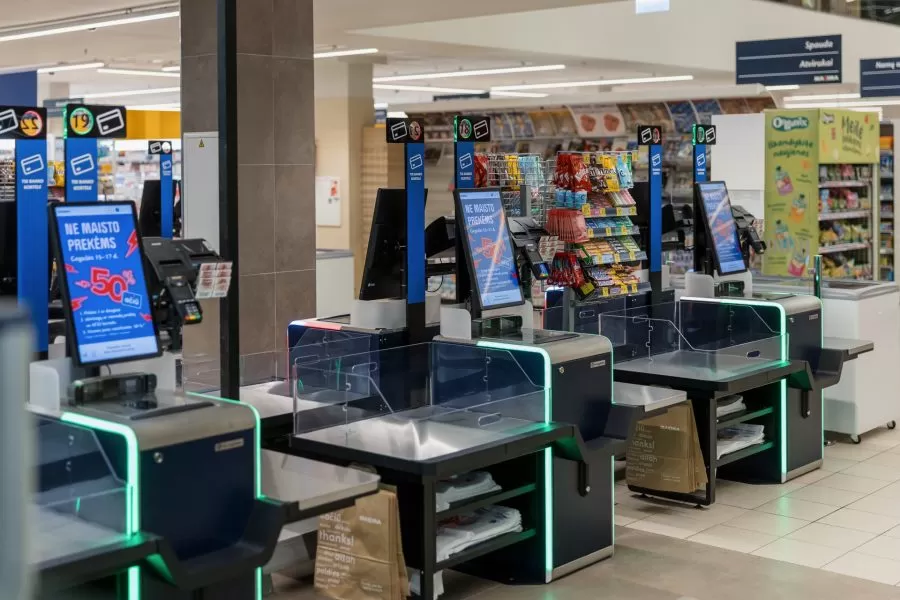
Lithuanian retailer Maxima has deployed an AI-powered loss prevention to mitigate checkout fraud and reduce losses. In stores already using the technology, fraud incidents have declined by more than 30%.
ScanWatch Retail Suite recognizes unpackaged products such as fruit, vegetables and bakery items and identifies cases where a customer selects the code of a lower-priced product while purchasing a more expensive one. It can also detect barcode switching and other checkout fraud scenarios.
The solution was developed by retail technology company Neto Baltic in collaboration with technology company Agmis. Maxima tested and refined the system together with the developers for nearly two years before expanding its use across more stores. Following the rollout in Lithuania, deployment in other Baltic markets is also being considered.
“Self-checkout fraud often involves customers deliberately selecting the code of a cheaper product while purchasing a more expensive one. A single incident can result in losses ranging from a few euros to several hundred euros,” said Ernesta Vareikytė, Head of Media Relations at Maxima. “Our experience shows that AI can help reduce these cases. In stores where the solution is in use, their number has fallen by nearly one-third.”
Maxima combines AI-based tools with other loss-prevention measures, including video surveillance and inventory monitoring. Where stock discrepancies are identified, the retailer analyzes their causes. AI adds another layer to this process by helping security staff identify potential incidents.
Prepared for Evolving Scenarios
Neto Baltic and its partners have been developing ScanWatch Retail Suite since 2019. The long-term cooperation with Maxima has helped to fine-tune the system for real-world store operations and improve it based on emerging fraud scenarios.
“We chose the solution based on the partners’ experience and the ability to work directly with a development team based in Lithuania,” Vareikytė said. “We knew from the beginning that store operations would present situations that could not all be anticipated in advance. That made continuous improvement an important part of the project. The development team has been able to respond to our feedback and adjust the solution accordingly.”
Maxima also emphasizes the importance of operational processes around the technology. Before the system is introduced in a store, procedures are established for responding to alerts, security employees are trained, and compliance with those procedures is monitored.
“During the long-term pilot with Maxima, we defined clear objectives, evaluated the capabilities of the solution and tested employee response processes,” said Rokas Budvilaitis, CEO of Neto Baltic. “That work created a strong foundation for deployment in additional stores. Maxima also carefully records which system alerts are confirmed, and that data helps us continue improving the AI model.”
No Negative Impact on User Experience
According to Neto Baltic, effective loss prevention must also preserve a smooth self-checkout experience. False system alerts account for less than 4% of transactions involving unpackaged goods.
“A high number of false alerts creates friction for both customers and store employees,” Budvilaitis said. “Retailers take different approaches. In some cases, scanning stops immediately after the system flags an action and an employee must intervene. In others, the customer is first given an opportunity to correct the selection independently.”
“For example, if potatoes are selected when the product is actually bananas, the checkout can ask whether the customer intended to choose bananas. This approach causes less disruption at checkout and helps reduce potentially confrontational situations between customers and employees. It demonstrates that loss prevention can be strengthened without undermining the customer experience.”


