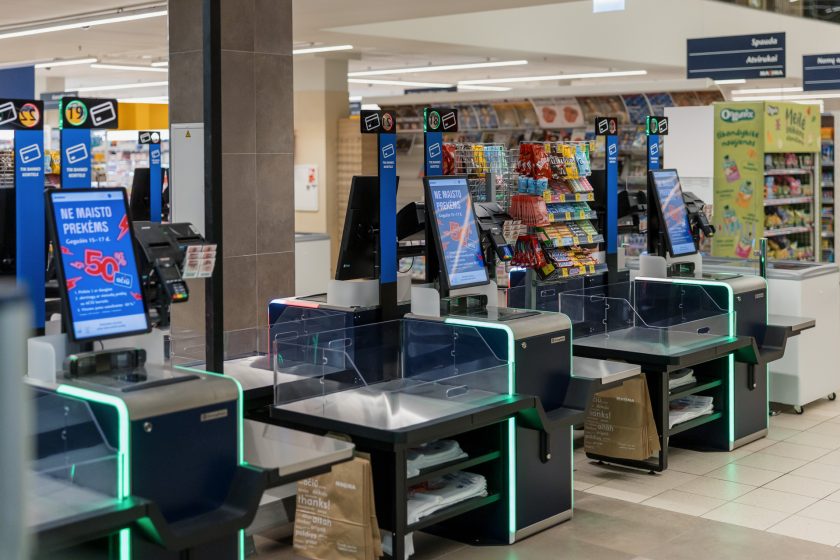
When the European Accessibility Act came into force last June in the European Union, it set out to make everyday devices and digital services—from ATMs and computers to televisions and public transport—more usable for people with disabilities. Self-checkout systems, now a standard fixture in retail environments, are also affected by the new regulations.
Yet despite the region’s rapid adoption of self-checkout technology, accessibility remains uneven. According to Rokas Budvilaitis, chief executive of retail technology company Neto Baltic, Baltic states rank among Europe’s leaders in the rollout of self-checkout systems. But only a fraction of these installations comply with the principles outlined in the EU directive.
“First self-checkouts in the region were introduced as early as 2008, making Baltic states one of the pioneers in Europe,” Budvilaitis said. “At the time, these systems were positioned as an additional checkout option alongside manned checkouts. Today, as self-checkout zones dominate store layouts, the need to ensure accessibility for people with disabilities has become significantly more pressing.”
While newly deployed systems increasingly incorporate accessibility features, retailers face a more complex challenge: how to retrofit legacy infrastructure already installed in stores.
At EuroShop, a major European retail technology trade fair, Partner Tech unveiled a universal keyboard module designed to address accessibility barriers. The add-on device can be mounted at wheelchair-accessible height and allows users to operate all self-checkout functions.
“The key advantage is its compatibility with systems from any manufacturer,” Budvilaitis noted. “Retailers, working with their existing partners, can implement the solution quickly and at relatively low cost. Installation takes just a few hours.”
Partner Tech also introduced a voice-controlled self-service terminal, initially developed for a fast-food chain but with broader applications in mind. The system enables users to navigate the interface and make selections entirely through voice commands—an approach that could significantly improve usability for visually impaired customers.
“In such cases, the entire user interface can be delivered through audio guidance, effectively acting as a voice-assisted checkout wizard,” Budvilaitis said.
Partner Tech is among the world’s leading manufacturers of self-checkout systems, payment terminals, and mobile retail devices. Neto Baltic is an official Partner Tech partner in the Baltic states.