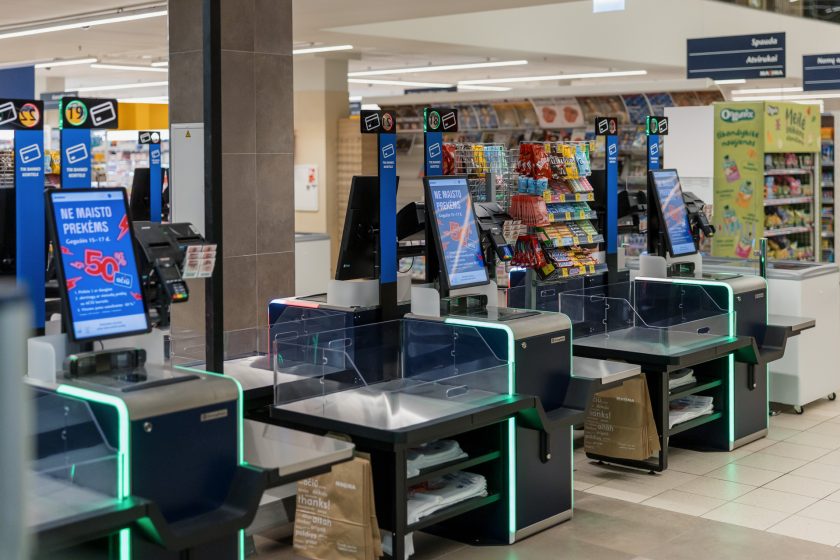
Increasing labor costs and shortage of retail workers is changing the landscape of retail. Due to these shifts retailers are increasingly adopting technological solutions that help to automate processes, increase operational efficiency, reduce losses and operating costs.
“Retail is a pragmatic sector. In retail, innovations are deployed not for the innovation sake, but to address particular challenges faced by the retail chain. Given that Baltics are a small retail market, our retailers are quick to deploy new solutions – yet “not everything everywhere and at once”. Therefore in one retail chain we might see a class-leading RFID solution, yet prices are displayed on paper shelf labels. In another, there might be ESLs, but inventory audits are performed manually”, says head of retail technology solutions provider Neto Baltic Rokas Budvilaitis.
According to R. Budvilaitis, these retail technology solutions receive the most attention from the Baltic retailers.
Self-checkouts
Following a store renovation, the self-checkout area is usually significantly expanded. The renovated stores feature only a few regular checkout lanes with all the customer traffic diverted towards self-service.
This change is dictated by both shoppers’ desire to shop at SCOs and the opportunity to reduce labor costs.
It is important to note that this year, SCOs are rapidly moving from supermarkets to specialty stores, especially in the DIY sector.
“Shoppers have become accustomed to using self-service in supermarkets and are surprised that they cannot checkout independently in large DIY stores. The price of SCOs for non-food stores is rapidly decreasing. So it’s no surprise that we are seeing them more and more often at gas stations, cosmetics stores, and other retail outlets,” said Budvilaitis.
Computer Vision Solutions
Artificial Intelligence and Computer Vision solutions have become standard features of self-checkouts. These solutions protect retailers from losses caused by barcode switching, picklist fraud, not scanning all basket items, or no-pay scenarios. These solutions also automatically recognize scanned unpackaged goods without the need to select them from the picklist menu, making checkout faster and frictionless.
In addition to SCOs, Artificial Intelligence is increasingly being used to evaluate the performance indicators of the entire store.
“In e-commerce, you can track how much time a buyer spent on the website, what products they viewed, and what led to the conversion. With the help of video cameras and AI installed in the store, this level of analytics can also be obtained in physical stores—monitoring customer movement around the store, evaluating the “hot” and “cold” zones of product placement, accurately calculate how long a customer waited for assistance from a consultant, how many shopping carts were left due to long queues at the checkout area, and much more,” said R. Budvilaitis.
In R. Budvilaitis opinion, due to improving and cheaper technologies, the performance of physical stores will be measured in the same way as online stores in the next decade.
Electronic Shelf Labels
Electronic shelf labels significantly reduce labor manhours required to update prices at the store. Prices can be changed via a few clicks across the whole retail chain, enabling to quickly introduce discount promotions or to react to the competitor campaigns. ESLs can also display additional useful information (e.g. shoe sizes available in stock; product ingredients) or be used to aid in-store navigation.
Another benefit of using SCOs is that they enable to centrally manage all retail chain in-store information.
“In addition to traditional price label sizes, A4 size labels or interactive shelf-displays are available. With pricing updates, retailers can update the in-store promotional media by using the same software. This way you may push the new discounted prices to the shelf labels and also update campaign promotional displays across all stores – centrally managing pricing and marketing channels”, says R. Budvilaitis.
RFID for apparel retail
RFID solutions enable retailers to track each individual item throughout the supply chain.
They allow retailers to quickly and efficiently receive goods, replenish stock, distribute goods between stores, and ensure that the right size, color, and model are available on the sales floor. Scanning RFID tags dramatically reduces the time required for inventory audits. RFID also functions as a merchandise security solution. RFID-tagged goods do not need to be tagged with hard tags in the store; they arrive at the store already tagged, with RFID-enabled security antennas installed in stores protecting against theft.
“RFID is an ideal fit for SCOs. The self-checkout can deactivate the RFID tag after paying for the item. RFID-tagged items do not use hard-tags, the store assistant is not required to manually remove them. With RFID the full shopping process can be completed autonomously”, says R. Budvilaitis.
RFID for fresh food
Fresh food products (meat, culinary etc.) have a limited shelf life. The ability to identify each item individually allows retailers to reduce food waste, respond quickly to expiry dates with price promotions and better plan product orders.
“For example, retailers are implementing source tagging solutions in their own culinary workshops. This, in turn, allows them to track goods throughout the entire supply chain – from production to the moment the goods leave the store”, said Budvilaitis.